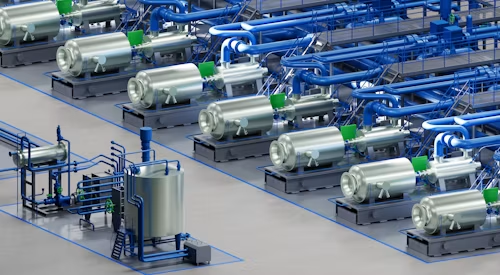
Introduction to Granular Recovery Technology
Wastewater treatment is one of the least discussed topics but an important one in keeping our ecosystem healthy. The ever-increasing population and industrialization mean that the need for effective treatment of sludge has never been greater. This is where Granular Recovery Technology comes into play.
Can you imagine how amazing it would be to optimize the entire process in terms of both efficiency and cost? That is precisely what GRT technology does in the area of sludge dewatering. We will discuss some case studies of this great technology in the following sections.
The Importance of Wastewater Management to the Granular Recovery Technology
Wastewater management is vital both for maintaining good health and ensuring environmental sustainability. Wastewater management helps reduce the pollution of our water sources and thus preserves aquatic ecosystems.
Because of the increasing rate of urbanization, more wastewater is produced each day. The failure to manage it efficiently may result in various health problems due to the presence of bacteria and viruses in water.
Furthermore, with wastewater management, people are able to reuse useful components such as water and nutrients. Thus, there is no need for people to use fresh water and chemical fertilizers.
In addition, places which take care of their management practices provide better living conditions because of a clean environment, which positively impacts tourism and economy in general.
Finally, innovations in this sphere help increase the efficiency of these systems. One of the most useful innovations is the advancement of sludge dewatering technology.
Case Studies: Real-Life Success Stories to the Granular Recovery Technology
One of the case studies that can be considered was related to a municipal wastewater plant which implemented the concept of granular recovery. The plant recorded a 30 percent increment in its sludge dewatering efficiency after six months of implementing this innovative technique.
There is also another actual success story related to an industrial plant having problems due to high quantities of organic wastes. By incorporating sludge dewatering innovations, it reduced its water usage considerably and saved on costs.
A further success story relates to a plant which had problems with using conventional techniques for a long period. By implementing mailbox restore capabilities through the integration with data management systems, they managed to get impressive results.
The above-mentioned actual cases illustrate both the flexibility and transforming power of innovative solutions.
Traditional Methods Granular Recovery Technology
Conventional techniques for the separation of water from sludge have traditionally used outdated and costly methods that do not produce efficient results. Gravity thickening, centrifugation, or vacuum filtration are some of the processes that were conventionally applied in the management of wastewater. Nonetheless, each of these conventional methods has limitations of its own.
Gravity thickening is prone to fail to give the desired results, thus resulting in too much residue. Centrifugation is an energy-intensive method and requires professional handling. In the case of vacuum filtration, there is the likelihood of clogging.
Granular recovery technology, however, is a more advanced technique of separating water from sludge. Through the use of technological advancement, this process improves upon the conventional techniques by becoming cost-efficient and enhancing the quality of the end product.
What Is Granular Recovery Technology?
Granular recovery technology means you can bring back small parts instead of replacing everything. With this method, you recover the exact item you need.
For instance, you might not restore a whole backup. Instead, you could pull back a single file or a specific folder. You may also restore one database record, a single email message, or a piece of an app.
Because the scope is smaller, the recovery work can be more focused. It can also be faster when you only have to replace a little information.
Granular recovery is usually done in a few steps.
First, the recovery tool or backup system picks the right restore point.Next, it lets you view the pieces inside the backup, like single files or specific items.
After that, you can bring back just those chosen items.
You do not have to swap out everything else in the live setup.
This is not the same as full system recovery.
With full recovery, you restore the whole machine, the full app setup, or an entire dataset.
Granular Recovery and Data Protection
Granular recovery is tied to today’s backup and disaster recovery plans. A good backup helps when a whole system goes down. It also helps when only one part of the data must be put back.
Because of that, teams might pair granular restoration with backup retention. They also look at recovery points, data security, and plans for keeping the business running.
Why Is Granular Recovery Useful?
Granular recovery is helpful for a clear reason: you can restore only what you need. If someone deletes one file by mistake, you may not want to roll back a whole backup. With a smaller restore, the missing item can be brought back, while the rest stays as it was.
There are also other upsides, such as:
- You can finish recovery faster
- Restores can be limited to the exact data you want
- Fewer changes mean less interruption for users
- Accidental deletions are easier to fix
- Backups can be used in a more flexible way
- You get better control during the recovery steps
Implementation and Cost Analysis
The adoption of Granular Recovery Technology involves thoughtful consideration and planning. The facilities need to analyze their current processes to incorporate this technological advancement properly.
Cost factors will play a major role in the implementation process. Although it may appear as an expensive undertaking, it may lead to significant savings in the future due to decreased power expenditure and increased efficiency of sludge dewatering.
Staff training is yet another critical aspect of implementation. It ensures smooth operation of the system and improved performance metrics.
You can also read about: Golden Gate Claude
Furthermore, one should consider maintenance cost factors when implementing this technology. Maintenance will help ensure proper function without any interruptions.
It is also beneficial for organizations to conduct the Return on Investment calculation. It will allow the visualization of financial benefits from such investments as advanced sludge dewatering systems, including granular recovery technology.
Future Possibilities and Potential Impact on the Wastewater Industry
There is huge potential that lies in the future of the granular recovery technology for the wastewater industry. The future is characterized by stringent regulations and increased environmental concern. Therefore, innovation will be key.
For instance, imagine a future where sophisticated sludge dewatering becomes commonplace. There will be large reductions in waste volume and cost savings in the process. Increased efficiency will mean that facilities can do much more work while consuming less energy.
Innovative technologies such as application-aware recovery technologies may enable operators to identify problems quickly and hence ensure that optimal conditions prevail in the entire process.
Furthermore, the integration of smart sensors will facilitate the provision of data analytics in real time. Facilities will therefore be able to adjust their activities accordingly for effectiveness.
As society increasingly embraces sustainability, such technology will certainly play an important role.
Final conclusion
Granular recovery is a practical way to bring data back in a targeted manner. Rather than restoring the whole system each time, it lets you pull only the parts you actually need. If you are looking up this idea in connection with Carolyn Eadie, write in a way that clearly separates what is verified about her from the general technical topic. That approach keeps the piece useful and reads more naturally.
Frequently Asked Questions
What is granular recovery technology?
Granular recovery technology allows users to restore specific files, folders, records, or other individual data items from a backup instead of recovering an entire system.
How does granular recovery differ from full recovery?
Full recovery generally restores an entire system, environment, or dataset. Granular recovery focuses on retrieving only the particular information that is needed.
Why is granular data recovery useful?
It can save time and reduce disruption when only a small amount of information has been lost or deleted. Users don’t necessarily need to restore unrelated data.
Can granular recovery restore deleted files?
Yes, where the backup or recovery system contains the required version of the deleted file. The available recovery options depend on the technology and backup configuration.
What is Granular Recovery Technology?
Granular Recovery Technology is an innovative approach in the field of wastewater treatment, which aims at optimizing the sludge dewatering process.
How does advanced sludge dewatering operate?
Advanced sludge dewatering represents the use of special techniques and equipment that help enhance the efficiency of the process. Advanced sludge dewatering not only decreases the costs related to sludge disposal but also improves the quality of biosolids.
What are some advantages of application-aware recovery in wastewater treatment?
Application-aware recovery provides an opportunity to obtain targeted solutions to the problem of recovery in wastewater treatment facilities. This helps in maintaining the data and processes that are critical in the process.
Can selective mailbox restore technique be applicable in the given situation?
Though the application of selective mailbox restore is generally associated with email systems, it can still help to think about something similar to implement in this field of wastewater treatment in order to increase its efficiency without influencing other systems.