Introduction to the Contractile Vacuole
Have you ever thought about how some tiny organisms survive in freshwater habitats? There is one important cell structure which allows them to cope with environmental conditions: contractile vacuole. It is not just a bag but a whole system, the purpose of which is regulation of osmotic balance in the organism and maintaining proper level of water. While studying the contractile vacuole in depth, we will uncover the secrets of its structure, functions, and life cycle. If you have always been interested in biology, then this article is for you.
The Contractile Vacuole Structure
The contractile vacuole is an organism that is very complex in its structure. In general, it is represented by a large round sac which is capable of expanding and shrinking. Such construction is very necessary for its main function which is the regulation of water.
The membranes surrounding the main compartment are necessary for transportation and movement. Their presence is very significant during the cycles of contraction and relaxation of the vacuole.
One of the special characteristics of the contractile vacuole is the presence of small canals through which water enters the vacuole and can be quickly discharged outside the cell.Moreover, in some species, there are multiple contractile vacuoles operating together according to their environmental adaptation.
Functions of the Contractile Vacuole
A contractile vacuole is a very important part that assists in maintaining homeostasis in the cell. It serves mainly as a regulatory organelle, helping to control the osmotic pressure in the cell.
First of all, it removes excess water. When living in freshwater, protists usually take in a lot of water due to osmosis. The contractile vacuole removes this excess amount to save the cell from bursting.
Moreover, it regulates the ion balance and concentration of nutrients. Controlling the internal environment of the cell, it makes sure that the conditions for metabolism are optimal.
This organelle also helps to maintain buoyancy in some organisms. It regulates its volume in order to affect the way an organism moves through water.
Being dynamic, this part of the cell helps the cells adapt quickly to new conditions. This is very important for living in different aquatic environments where conditions are constantly changing.
Cycle of the Contractile Vacuole
One of the unique features of the contractile vacuole is its cycle. With the help of it, the process of regulation of excessive fluid in cells is carried out. Firstly, water collects in the vacuole.As soon as the vacuole gets filled, the pressure increases.
As soon as the threshold of pressure is achieved, there is a violent contraction of the vacuole. It leads to the discharge of fluid from the contractile vacuole through the cell membrane. The process of ejection is crucial to ensure osmotic balance.
Finally, the contractile vacuole undergoes a recovery period when, with the help of pumps, the equilibrium is restored. Ions return to the cytoplasm and new water enters the contractile vacuole gradually.
Such a cyclic process allows cells to keep the proper water balance. Thus, organisms remain hydrated without the risk of swelling or bursting.
What Does a Contractile Vacuole Do?
A contractile vacuole is a type of cellular organelle that resembles a water management system. It is widely present in protists found in fresh water, such as Amoeba and Paramecium.
Freshwater habitats typically contain lower concentrations of dissolved matter than the cells themselves so that water tends to filter in, causing the cells to swell up and eventually burst. A contractile vacuole is there to collect and expel that water back out of the cell.
What Is the Function of a Contractile Vacuole?
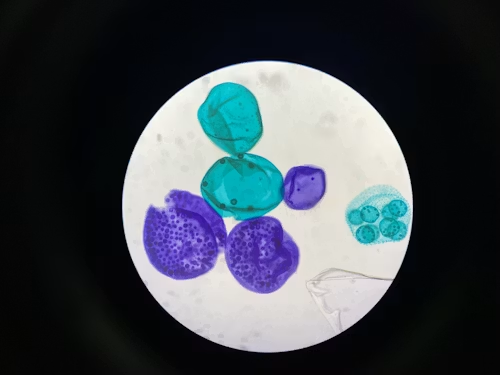
The contractile vacuole functions in two phases: the filling stage and the contraction stage. Initially, as the contractile vacuole accumulates extra water from the cytoplasm with the help of specialized structures called radial canals or collecting tubules, it grows in size as it fills up. When it becomes full, it suddenly contracts and discharges the excess water outside the cell into its surrounding environment. The contractile vacuole, in turn, is a crucial part of the organism’s water regulation mechanism. Due to its ability to fill up with excess water during the filling phase and get rid of it during the contraction phase, the organism can control the internal water quantity successfully.
What Is the Importance of the Contractile Vacuole?
The contractile vacuole plays an important role in the bodies of various unicellular organisms that live in freshwater environments where they are affected by external factors that could damage normal functions within the cell and lead to cell lysis. The contractile vacuole is capable of removing extra water from the cell repeatedly through osmosis. Its searching function is done through collection and discharge of extra water which helps with water regulation and protects cells from continuous water overload.
In the absence of proper osmotic regulation, water will accumulate and deteriorate the cellular functions and lead to rupture of the plasma membrane.
Role of Contractile Vacuole
The contractile vacuole’s primary role is to expel surplus water from the cell. It is one of the processes that are vital in maintaining the integrity of the cell. Some of its important functions include: Osmoregulation: The cell keeps its water equilibrium. Disposal of excessive water: The vacuole collects water entering the cell through osmosis.
Prevention of the cells’ swelling: Protects freshwater organisms from the excess absorption of water. Maintenance of the internal state: The vacuole ensures that the cell environment is stable. The contractile vacuole does not directly perform a function similar to a digestive organelle but rather acts more as a regulator of water in the body.
Importance in Different Organisms
A contractile vacuole is of utmost importance to different living things, especially in the case of protozoa. These one-celled organisms depend on this particular organelle to maintain the right amount of osmotic pressure in their habitat.
Freshwater environments bring about a continuous intake of water, which would otherwise pose a great challenge. This particular cell structure comes in handy by helping the organism get rid of the excess liquid that comes into contact with it.
You can also read about: Ketoses
Different organisms show various adaptations of the structure. Some of the protozoa have more than one contractile vacuole at a go, which helps in efficient removal of waste products.Even in the case of multicellular organisms such as sponges and algae, the same kind of function is exhibited by the structure.
Abnormalities and Diseases Related to the Contractile Vacuole
The disorders of contractile vacuoles can be extremely harmful to the health of many living creatures, especially protists. The malfunctions of these organelles interfere with osmoregulation and consequently make cells swell or dehydrate.
There is a health problem called. which arises when the vacuoles cannot discharge water from the cells properly. Under these circumstances, cells suffer osmotic shock and can even burst due to this disorder.
The malfunctions of contractile vacuoles can be caused by genetic mutations affecting proteins for vacuole functioning. Thus, such disruptions do not only interfere with the activity of cells, but also affect the health of whole organisms negatively.
Final conclusion
The contractile vacuole is an important structure in the cells of freshwater animals because it enables them to maintain a balanced environment within their cells. Through the process of collecting and periodically expelling excess water, it has a key role in the process of water regulation so that the cells do not swell up too much. Its role in organisms like Amoeba and Paramecium makes it an important concept in a lot of different areas of science such as cell biology, protists, osmosis, and homeostasis.
Frequently Asked Questions
What purpose does a contractile vacuole serve?
The primary purpose of a contractile vacuole is to help in transporting excess water out of a cell and to help in water balance through osmoregulation.
What is the location of contractile vacuole?
Contractile vacuoles are found in freshwater protists, including Amoeba and Paramecium.
What is the importance of the contractile vacuole in freshwater organisms?
Freshwater organisms are naturally exposed to water entering their cells through the process of osmosis, and this excess water is expelled by the contractile vacuole to avoid swelling of the cell.
What is a contractile vacuole?
A contractile vacuole is an organ that exists mainly in particular protists and a few unicellular organisms. It performs the duty of balancing the water content within the cell.
How does a contractile vacuole work?
The collects any excess water content in the cytoplasm. Then, it contracts itself so as to release water to the exterior of the cell.
What are some of the organisms that have contractile vacuoles?
Contractile vacuoles exist in protists such as paramecium and amoeba. These microorganisms depend on the existence of this organ in order to be able to survive.
Are there cases when something goes wrong with these structures?
Definitely, there could be instances when something goes wrong with a through defects in its structure or malfunctioning. This results in swelling of the cells or bursting due to excess water accumulation.
Is research being done on the working mechanisms of these structures?
Certainly, scientists conduct researches into the adaptation of different kinds of contractile vacuoles to different habitats among different species.